New Trends in Vaginal Rejuvenation: Scientific Advancements, Clinical Evidence, and Considerations

Vaginal rejuvenation has undergone significant advancements in recent years, with novel technologies and therapeutic interventions emerging to address both aesthetic and functional concerns. Women seek these procedures for a range of reasons, including post-pregnancy recovery, menopause-related changes, sexual dysfunction, and relief from urinary incontinence. With contemporary developments in regenerative medicine and minimally invasive procedures, vaginal rejuvenation is now more effective, accessible, and supported by emerging clinical research.
This article explores the latest trends in vaginal rejuvenation, highlights relevant clinical studies, and provides an evidence-based perspective on their safety and efficacy.

The Emergence of Non-Surgical Vaginal Rejuvenation

Historically, vaginal rejuvenation was primarily associated with surgical procedures such as labiaplasty and vaginoplasty. While these remain viable options, non-surgical alternatives are gaining traction due to their reduced downtime, lower complication rates, and promising outcomes.

Laser and Radiofrequency (RF) Therapies
Laser and RF-based modalities are at the forefront of non-surgical vaginal rejuvenation. These technologies leverage controlled thermal energy to induce neocollagenesis, enhance tissue elasticity, and improve mucosal hydration. Popular devices in this category include:

  • Fractional CO2 Laser Therapy (e.g., MonaLisa Touch, Femilift): Targets vaginal atrophy, dyspareunia, and mild laxity by promoting epithelial regeneration and fibroblast proliferation.
  • Radiofrequency (e.g., ThermiVa, Votiva): Utilizes controlled RF-induced thermal energy to stimulate collagen and elastin synthesis, improving vaginal tone and neuromuscular function.

Clinical Evidence
A randomized controlled trial comparing fractional CO2 laser therapy to vaginal estrogen therapy in women with genitourinary syndrome of menopause demonstrated comparable efficacy in symptom relief, including vaginal dryness and dyspareunia, over six months. The study reported high patient satisfaction rates (70–80%) with minimal adverse effects (PubMed ID: 31574047).
However, the U.S. Food and Drug Administration (FDA) has raised concerns regarding the marketing of energy-based devices for vaginal rejuvenation, citing the potential risks of burns, scarring, and persistent discomfort. The FDA advises patients to consult with board-certified specialists before undergoing such treatments.

Platelet-Rich Plasma (PRP) Therapy – The “O-Shot”

Platelet-Rich Plasma (PRP) therapy, commonly referred to as the O-Shot, has garnered attention for its purported ability to enhance sexual function, tissue regeneration, and urogenital health. The procedure involves autologous PRP extraction followed by localized injections into the vaginal and clitoral tissues to stimulate angiogenesis and neurogenesis.


Potential Benefits and Clinical Research

  • Enhancement of orgasmic response and sexual satisfaction
  • Increased vaginal lubrication due to improved vascularization
  • Tissue repair and regeneration in cases of vaginal atrophy
  • Reduction in stress urinary incontinence symptoms

Although anecdotal reports indicate positive outcomes, there remains a paucity of large-scale, randomized controlled trials substantiating PRP’s efficacy in vaginal rejuvenation. Further clinical research is necessary to establish standardized protocols and long-term safety profiles.

Radiofrequency Microneedling for Vaginal Tightening

Radiofrequency microneedling integrates microneedle-induced microtrauma with RF energy to potentiate collagen remodeling and fibroblast activation. This technique is being explored for vaginal laxity, pelvic floor strengthening, and overall mucosal rejuvenation.
Why It’s Gaining Interest

  • Demonstrates superior collagen remodeling compared to traditional laser therapies
  • Can be applied for external (labia tightening) and internal (vaginal canal firming) indications
  • Offers a non-surgical alternative for women seeking vaginal tightening without extensive downtime

Despite its potential, rigorous clinical trials evaluating the long-term effectiveness and safety of RF microneedling in vaginal applications remain limited.

Hyaluronic Acid (HA) Fillers for Vaginal Rejuvenation

Hyaluronic acid-based fillers, commonly used in dermatological aesthetics, are now being applied in urogynecology to enhance vaginal hydration, structural integrity, and neurosensory function.


Applications and Clinical Studies

  • Labial Augmentation: Restores volume and improves the external genitalia’s aesthetic appearance.
  • G-Spot Amplification: Theoretically enhances sexual pleasure, though clinical validation remains sparse.
  • Moisturization Therapy: Provides relief for vaginal dryness and atrophy in postmenopausal women.

Preliminary studies suggest that HA-based fillers exhibit comparable efficacy to estrogen therapy in alleviating symptoms of postmenopausal vaginal atrophy. However, further trials are warranted to ascertain optimal dosing and duration of effect.

Stem Cell and Regenerative Medicine Therapies

Stem cell therapy represents the cutting edge of vaginal rejuvenation, leveraging mesenchymal stem cells (MSCs) or adipose-derived stem cells (ADSCs) to regenerate vaginal mucosa, enhance neuromuscular function, and restore urogynecological health.

Current Research and Challenges

  • Potential to restore vaginal elasticity and sensory function
  • Regeneration of damaged vaginal epithelium and connective tissues
  • Long-term effects remain under investigation, requiring additional clinical trials

As of now, stem cell therapy for vaginal rejuvenation remains largely experimental and is not widely available outside research settings.

Bioidentical Hormone Therapy (BHT) for Vaginal Health

Bioidentical hormone therapy (BHT) has gained traction as a supportive approach for managing menopausal vaginal atrophy and hormonal deficiencies contributing to urogenital symptoms.

Clinical Advantages

  • Enhances epithelial hydration and elasticity
  • Supports collagen synthesis and neuromuscular function
  • Available in various forms (creams, pellets, sublingual troches, injections)

Although BHT provides symptom relief, its long-term impact compared to conventional hormone replacement therapy (HRT) requires further investigation.

Combination Therapies for Optimized Results

Given the multifaceted nature of vaginal rejuvenation, many specialists advocate for combination therapy approaches to enhance clinical outcomes.

Examples of Synergistic Treatments

  • Laser Therapy + PRP: Augments tissue repair and collagen induction.
  • RF Microneedling + HA Fillers: Offers structural reinforcement and hydration benefits.
  • BHT + Energy-Based Devices: Addresses hormonal deficiencies while enhancing tissue regeneration.

The integration of combination therapies allows for more personalized and comprehensive vaginal rejuvenation strategies.

Considerations Before Opting for Vaginal Rejuvenation

Before undergoing any vaginal rejuvenation intervention, it is essential to evaluate:

  • Consultation with a Specialist: Seek expert guidance from a board-certified urogynecologist or aesthetic gynecologist.
  • Understanding the Risks: Common adverse effects include transient swelling, discomfort, or erythema.
  • Realistic Expectations: Outcomes may vary based on age, hormonal status, and baseline vaginal health.
  • Cost & Maintenance: Many treatments necessitate multiple sessions and periodic follow-ups.

Conclusion

The landscape of vaginal rejuvenation is advancing rapidly, driven by technological innovations and evolving clinical research. From laser-based modalities and PRP therapy to stem cell applications and combination strategies, a growing number of options are now available for women seeking functional and aesthetic improvements.
As these treatments become more widely accepted, a rigorous, evidence-based approach remains crucial to ensuring safety, efficacy, and patient satisfaction. Consultation with experienced healthcare providers is paramount to selecting the most appropriate intervention tailored to individual needs.
If you have experience with these treatments or are considering vaginal rejuvenation, feel free to share your insights and questions in the comments below!

The NowMi Treatment- Clinical Evidence

Clinical Evidence supporting the NowMi Treatment

The NowMi treatment was tested in a clinical study performed by a third party GLP certified laboratory. The clinical study was intended to evaluate the safety and efficacy of the NowMi PRO treatment for improving skin texture, skin smoothens and for immediate and long-term overall skin appearance improvement when used in a controlled panel test.

The treatment protocol included:

Daily cleansing: six weeks of daily facial cleansing at night with the NowMi PRO sonic device and the NowMi facial cleansing gel.
Weekly treatments: six facial rejuvenation treatments carried out once a week with NowMi PRO sonic device that uses the vitamin C effervescent tablet and the NowMi lubricant gel.

Results:

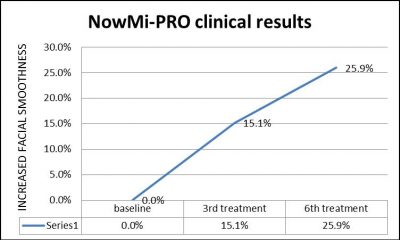
Statistically significant results (p<0.05) obtained. After 3 weeks of treatments, facial skin smoothness increased by 15.1%, and after 6 weeks smoothness increased by 25.9%. No adverse effect were recorded and the safety and efficacy of the NowMi PRO treatment was proven.

The NowMi PRO Kit

The NowMi Pro has two functions – the NowMi Pro Daily is designed to keep the skin clean and moisturized on a daily basis, and the NowMi Pro Weekly provides a ‘spa-like’ deep facial that slows down the signs of aging, revitalizes the skin and protects it against extrinsic factors such as smoke and pollution.
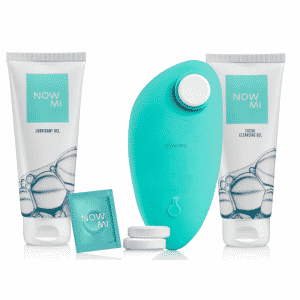
The NowMi Pro treatment kit


Clinical Study Methodology

The methodological approach used to evaluate whether or not the product tested has any effect on facial skin rejuvenation included:  Objective (instrumental) measurements for capturing and analyzing skin texture.

Following the application of a product on human subjects (see Colipa Guidelines Efficacy 2008),  the instrumental tests are performed with instruments that can precisely measure given parameters, according to a defined principle. Measurements are made under the control of a suitably qualified professional and use precise criteria (Colipa Guidelines Efficacy 2008).

To capture and evaluate skin’s texture, Canlfield’s VISIA system was used. The VISIA system consists of the VISIA imaging booth and VISIA software and can capture and store facial images using standard lighting, cross-polarized flash, and UV flash. After capturing images, the software automatically isolates or “masks” specific areas of the face and then performs an extensive analysis of these areas to evaluate the skin features.

The study was carried out on a panel of 10 women, 8 with normal skin and 2 with sensitive skin.  The women were aged 32.8±4.4 years.

The table below depicts the sex, age and skin type of the subjects participated in the study.

Subject No. Skin type Sex Age
1 Normal skin Female 30
2 Normal skin Female 36
3 Normal skin Female 30
4 Normal skin Female 26
5 Normal skin Female 26
6 Normal skin Female 39
7 Normal skin Female 34
8 Normal skin Female 34
9 Sensitive skin Female 38
10 Sensitive skin Female 35


Results of objective measurements of skin texture

Texture is primarily an analysis of skin smoothness. It is affected by wrinkles, pore size and general roughness of the skin. The results of skin texture as measured by the VISIA system are presented in the table below for each volunteer.

After 6th treatment After 3rd treatment Baseline Volunteer No.
287 358 438 1
113 74 113 2
77 98 80 3
447 531 630 4
736 701 812 5
285 294 354 6
222 265 292 7
126 185 168 8
281 337 553 9
257 401 383 10
283.10 324.40 382.30 Average
192.21 191.34 235.00 St.dev.
 
A
A
NowMi Clinical results
Graphical representation of facial skin smoothness improvements compared to baseline and after the 3rd and 6th treatments. After 3 weekly treatments facial smoothness increased by 15.1% and after 6 weekly treatments facial skin smoothness continues to increase to 25.9%.


Conclusions:

  • 70% of subjects presented increase in facial skin smoothness after 3 weekly treatments compared to baseline.
  • 90% of subjects presented increase in facial skin smoothness after 6 weekly treatments compared to baseline.
  • A statistically significant improvement of facial skin smoothness was measured both after 3 weekly treatments and at the end of the study compared to the baseline.


NowMi Pro is now on sale with Special Offer: Buy now a NowMi Pro Kit from the inventor of OxyGeneo and receive Free of Charge a NowMi refill kit (valued at $99) that will give you 3 extra months vitamin C oxygen facial treatments at home.